How can I help you today?
C
Your Cozy Novel
·
Project
⋯
cozy_fantasy_setup_prompt.md
MD
Please read the framework and the style pack in the source files, then read the setup prompt, and then execute it.
Let's build your novel.
First, give me your starting point.
This can be anything: a single word, a magical craft, a creature, a character idea, a community, a mood, a scene you can picture, a book or show you admire, or a detailed wishlist of everything you want. There's no wrong answer and no wrong amount.
Or say "surprise me" and I'll build the concept from scratch.
Reply…
This can be anything…
Or say "surprise me" and I'll build the concept from scratch.
What a seed. Rich, specific, and genuinely original: the cat-memory ghost as belonging's emotional template, the comedy of a protagonist not understanding herself, the animal rescue as unconscious mirror of her own experience. That's a novel with a real heart underneath it.
Let's build the world it lives in.
Reading your seed and matching it against setting archetypes ›
Step 4 of 18 · World & Community
You asked to be surprised on setting: somewhere a woman starting over could put down roots. Here are three worlds built around your premise, each genuinely distinct in feel and what kind of story it produces.
OPTION A · The River-Crossing Town
A market town where two roads and a navigable river all meet: a waystation that has always been in the business of receiving people who arrive with nothing but themselves. The inn has a saying carved above the door: "All roads cross here twice."
The belonging shape: No questions asked. This community doesn't ask where you came from. It asks what you need and what you can offer. A woman who doesn't know her own history is not unusual here. She fits the town's existing groove before she even knows there is one.
The rescue: The river has mild enchantment. It deposits things that need finding. Lost cargo, unusual animals, occasionally people. The fantastical creatures that pass through with traders end up here, because here is where things end up.
Vibe: Wide skies, willows in the water, market days, the smell of mud and frying fish.
Hook: She arrives by accident. The town receives her like the river deposits everything else: without fuss.
OPTION B · The Forest-Edge Town
A community on the boundary between the settled world and an ancient forest that is unambiguously alive. The forest isn't hostile. It's complicated. It has memory, opinion, and a tendency to change its internal geography when it's in a mood. Briarhold has a Forest Warden whose job is part diplomat, part guide, part rescuer.
The belonging shape: Living beside the unknowable. The town has a specific wisdom: it knows how to live beside something vast and complicated without either controlling it or being consumed by it. That's a lesson the protagonist will need.
The rescue: The forest produces creatures that don't exist anywhere else. Some fantastical. Some are mundane animals that have been in the forest so long they've absorbed something of it and are no longer quite ordinary.
Vibe: Cobbled lanes that become dirt paths that become forest floor in ten minutes' walk. Leaf-mould, wood smoke, and something green and alive that has no name.
Hook: She is living beside something vast inside herself. The forest-edge community is doing the same thing on a town scale.
OPTION C · The Island Town
A small island accessible by a twice-daily ferry. Close enough not to feel isolated, far enough that coming here is a deliberate choice. The island has a long tradition of collecting what washes up. Goods, animals, occasionally people. And finding each a use or a home.
The belonging shape: Choose, then earn. Islanders are warm, but full welcome only extends once you've proven you mean to stay. The protagonist arrives by accident, and chooses, over the course of the novel, to stay. That choice carries weight in a community that understands what choosing means.
The rescue: Sea-adjacent fantastical animals, shore creatures with enchantments, birds blown off course from migrations. The island's contained geography means the rescue is genuinely embedded in the community.
Vibe: Salt air, sea-light, stone buildings that look grown rather than built, wildflowers in the cracks of the sea walls.
Hook: To be truly known by people who have decided you're theirs.
My recommendation is Option B, the forest-edge town.
Your protagonist is a woman living beside something vast inside herself: five years she can't remember, an identity she can't access, a past that exists as instinct and fragment. The forest-edge community knows how to live beside something they can't fully understand or control. That's a thematic resonance that will work through the whole novel without ever being stated. The Forest Warden, someone whose entire life is about finding lost things and guiding them back, is a gift of a relationship anchor.
That said: Option A's "this is where lost things end up" has a beautiful logic of its own. You can also combine, modify, or take the story somewhere entirely different.
I lean B and completely agree with you. But I can't let go of "this is where lost things end up." So B but with a tiny bit of A.
Perfect combination. Here's how they merge…
Reply…
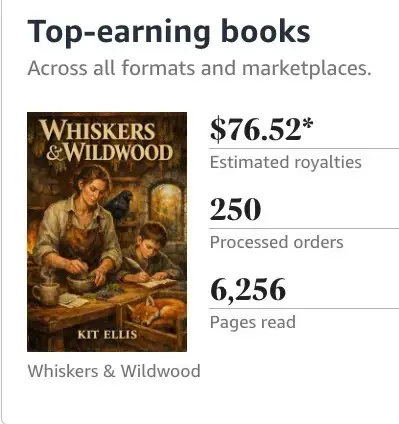
Whiskers & Wildwood is the working title (only Wildwood would potentially change).
Whiskers & Wildwood. Warm, specific, immediately tells you what kind of book this is. The Wildwood is already the name of the ancient forest at Briarhold's back, a happy piece of consistency.
Locked in. All creative decisions made.
I'll build your planning documents now, generated one at a time, each added to your Project before I produce the next.
Created 5 files in your Project ›
Your World Bible, Story Bible, Character Profiles, Chapter Outline, and Story State are ready, the full architecture for Whiskers & Wildwood, Book One.
Ready to write the prologue whenever you are.
Time to write chapter 5.
Writing Chapter 5, voice held to the Framework and Style Pack ›
The cellar smelled of cold stone and spilled cider, and underneath that, faintly, of gloamling.
Marta stayed on the stairs. Six weeks of this had taught her exactly how far down she was willing to go, and it was four steps. "They're behind the barrels," she said. "They're always behind the barrels."
Nell crouched on the packed earth and waited. She didn't coax and she didn't reach. She simply became, by degrees, the stillest thing in the room, until the dark under the barrels grew a pair of eyes. Then another. Then five more.
"There you are," she said softly. "You've picked yourselves a terrible corner."
Validated word count and organized the chapter output ›
Good. 3,471, solidly in range. Copying to outputs and updating the Story State now.
Ran a command, created a file, updated story state ›
Chapter 5 · THE CELLAR PROBLEM · 3,471 words.
What this chapter did:
External: Nell resolves Marta's six-week gloamling problem. Not by removing them but by reading what they needed and finding them a better corner. Earns her first month's accommodation credit. Handles an injured hen for the cheese stall-holder. Word begins moving through Briarhold.
Internal/belonging: The gloamling resolution is the first demonstration of a quality that is specifically hers: an attunement to animals she cannot account for and nobody else can replicate.
Cai: Their first real conversation, longer than the errand required. He asked a question she had no clean answer to, held the non-answer without pressing, and showed something of himself (the map, the dry humour, the way he gives information as freely as he'd want to receive it).
Download the updated Story State, delete the old one from your Project files, and add this new version. Ready for Chapter 6 whenever you are … Pell and Spite incoming.
chapter_05.md
3,471 words · drafted
↓
story_state.md
updated · after Chapter 5
↓
Kindle Edition
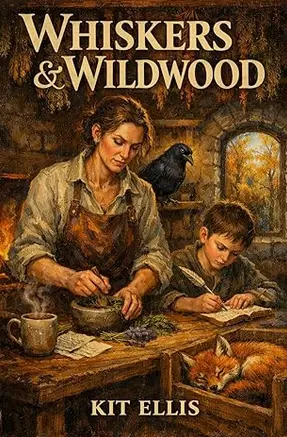
Whiskers & Wildwood: Book One
by Kit Ellis (Author) · Kindle Edition
★★★★☆
4.3
·
36 ratings
Read free with Kindle Unlimited
-93%
$0.99
Print List Price: $14.99
Available now, delivered instantly to your Kindle
Buy now with 1-Click
Read for free